 Back to list
Elica, a line on a single point
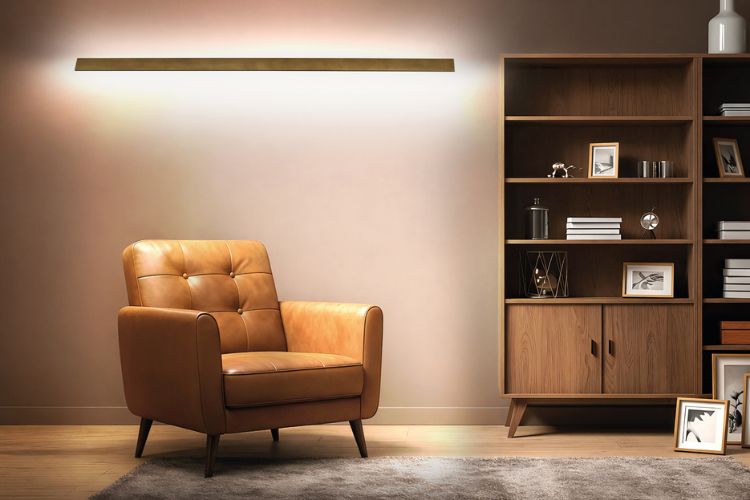
You look at Elica from a distance before you understand it. Up close it looks like one of many linear wall lamps. Then it lights up, and the light comes out everywhere, even from the ends, where others leave a void.
The body is aluminium, low profile: 7 cm high, constant across all sizes. On the wall the mark is always the same, a thin horizontal line (or vertical, mounted as a torch). Five finishes, all monochrome: aluminium, brushed bronze, butter white, black, matte gold. The surface runs uniformly from end to end, and this works in favour of the line.
The technical point that sets Elica apart from other linear lamps is the fixing. Almost all back-plate appliques sit against the wall like closed boxes, their end caps stopping the light: the result is a projection with two shadow whiskers on either side of the body. Elica is supported at the centre by a single pivot; light emerges along the entire length, including from the ends, and the wall receives a uniform projection, with no cuts and no dark margins.
The central pivot isn’t only a fixing. On that same joint the lamp pulls out from the wall: projection ranges from 11 to 13.5 cm, an excursion of just over three centimetres, enough to change the quality of the reflection. Closer to the wall the light is crisp; further out, it softens. Still on the joint, the lamp rotates: aim it up, down, diagonally, or mount it vertically as a torch.
All three sizes are available in Dim to Warm: at full brightness Elica returns a natural light at 3000K, and as you dim, the colour temperature drops to 2200K, a warm orange, almost candle-coloured. It’s a temperature control that takes a cue from the Nordic countries, where the quality of light matters more than the quantity, and which recalls, in LED form, the behaviour of old domestic halogens: clear at full power, warm when dimmed.
What distinguishes Elica sits in details that work beneath the surface (the central pivot, the excursion on the joint, the shifting colour temperature). Things the lighting designer appreciates, like when you realise the same lamp solves ten different positions in the same project.

