 Back to list
Eccentrico, a technical system becomes an architectural gesture
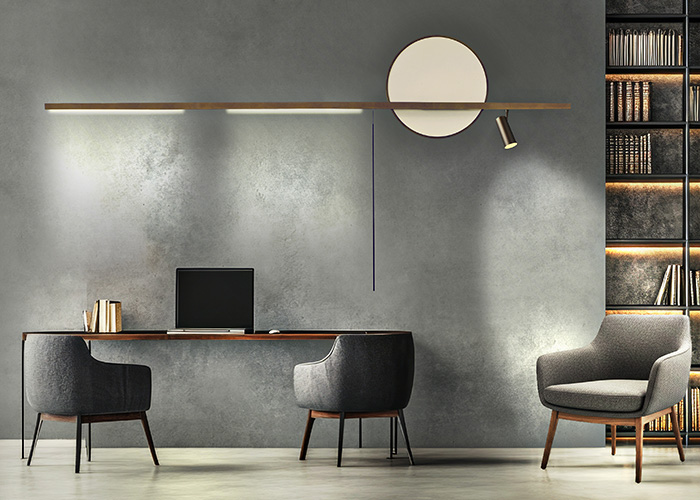
A configurable track with direct and indirect emission, independent control of each light point: a system designed around the project.
Track lighting usually has a straightforward job: get light where it needs to go, efficiently and flexibly. Eccentrico starts from a different premise, taking a familiar technical element and giving it architectural weight.
The central circle acts as a visual anchor, the fixed point around which the luminous path unfolds. The track lifts off the ceiling, draws a suspended line, and reaches walls or upper planes through directed blades of light. Wood enters the composition as a reflective, tactile element — warm and slightly unexpected. When light hits the surface, it picks up the grain and shifts with every angle.
Eccentrico is a design statement. An object that shapes the room, not just illuminates it.
Compositional freedom and modularity
The system is built around a central unit that houses the electronics and anchors the project. From there, 1.5, 2 and 3-metre modules extend outward, proportioned to the space or stretched further with additional tracks.
Extensions can intersect, change direction, and layer visually the main module and add-on elements can hang at different depths from the ceiling, creating dynamic compositions that either follow the architecture or cut against it with a deliberate, contemporary mark.
Wall- or ceiling-mounted, horizontal or vertical, Eccentrico works across a range of contexts: a hospitality headboard, a residential living area, a meeting room, a professional studio. It draws with light rather than just distributing it, fitting the space without losing its own formal identity.
The culture of light: control, dim to warm, scenes
Where Eccentrico earns its complexity is in how it handles light. An integrated electronic unit controls each emission type independently: direct light onto work surfaces, orientable spots, and indirect uplight toward the ceiling can each be activated and adjusted on separate channels, building different scenes within the same room.
For the designer, this means precise control without external systems or fragmented solutions.
Spots are addressable and assignable to distinct channels, so each point of light can respond to a specific need. In a hotel room, for instance, the reading lights on either side of the bed can be managed separately while a soft diffuse wash stays on the ceiling. Dim to Warm technology shifts the colour temperature during dimming, from a more neutral white toward warmer tones as the evening settles in.
This level of control reframes what lighting design actually means. It’s not about illuminating surfaces; it’s about defining visual comfort and atmosphere. Eccentrico becomes an instrument for working with light as a sensory material, something that changes how a space feels to be in.
An object for people who want something different
Eccentrico is for those who treat light as a design decision, not an afterthought. It’s made for architecture practices, interior and lighting designers, and anyone working on residential projects with character, hotels, and executive spaces where every element is accountable to the whole.
It asks for intention. The substantial scale, the possibility of extended linear runs, the integration of material and technology — these make it right for projects with a clear point of view. In those spaces, Eccentrico doesn’t just occupy a wall or a ceiling. It becomes part of the architectural narrative.
A choice for those who want to propose something distinct: formal expression and technical control in a single gesture.

