 Back to list
50 shades of grey
This villa in Calco, in the province of Lecco, has been rebuilt from a rustic state. It is a house designed for a family of 4 with the possibility of using up to 6/8 guests.
The new building was modified inside at the request of the owners, who wanted the possibility of having separate rooms for the various guests and a large living area.
The living area consists of a single and large room that contains an entrance, living room, dining area and kitchen. Focal points of this open space are the large dark gray, stone effect counter wall, which contains the TV and an imposing table whose top is made of a single piece obtained from a tree trunk. An element this, like others in the home, which deliberately goes against the general linearity: the scent and warmth of the wood and the feel to the touch make this table a plastic element.
By eliminating the plank that divided it from the living room, the staircase went from being a simple service element to another key point in the living area. Each intervention was designed to highlight it and integrate it into the environment: it was placed on a platform illuminated by small spotlights, it was painted with a material effect, the steps are monoliths in cement-effect porcelain stoneware and the handrail, completely invisible during the day, it becomes a continuous beam of light in the evening. Finally the parapets were replaced by glass panels that go from the basement to the first floor.
The dominant color of the interior is gray, in its various shades, with some small points of color to further enhance the homogeneity. Cold colors, therefore, but with punctual color elements present in all the various environments that create a sense of hospitality and elegance.
Upstairs, the exposed beams of the ceiling have been bleached and the general tones are always the cold ones of the rest of the house. For each room, the favorite color of the family members who live there was added: mustard in the master bathroom, blue for the younger daughter’s bedroom and green for the older daughter’s bedroom. The two girls’ rooms are connected by a common walk-in closet, which allowed the designer to make the best use of even the lowest spaces in the attic area.
The lighting of this house has played a fundamental role in creating different moods in the various environments. The large living space has been equipped with spotlights near the windows, indirect and suffused lights in the TV area and a geometric illuminating element on the large wall facing the windows. For the kitchen, more technical lighting was chosen, with ceiling profiles that hide almost from view and small spotlights on the work surface and snacks.
As soon as you go up to the first floor you will find theICONE Luà. We needed an indirect light that allowed, with its own intense but at the same time soft beam, to illuminate the splendid bleached wooden roof. The choice fell on Luà as it was characterized by a swiveling flat disk which made it possible to direct the light beam in the most scenographic way possible. Furthermore, their circle was in perfect contrast with the porthole that was in front: two circles, two sources of lighting.
During the day, the light enters through the porthole, and depending on the position of the sun, the light beam moves and illuminates different parts of the roof and walls; in the same way, in the evening, the adjustable circle of the Luà accompanies people to their rooms with beams that are always customizable, intense but never annoying.
The architect has also re-proposed the beautiful ICONE product in the master bathroom as the light point was very misaligned from the center of the room, therefore the adjustability of this luminaire has once again come in handy.
There were many constraints in this environment: pitched roof, decentralized light point, different areas to be illuminated. Therefore having a fixture that would allow intense light, capable of illuminating the whole environment, but not annoying to the eyes and adjustable, has solved all the possible drawbacks of the geometry of the room.
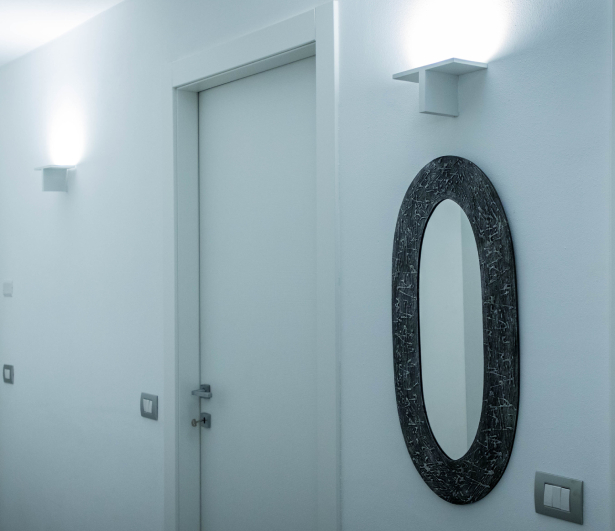
These wall lamps are designed in different colors, but in this case total white was chosen. The architect wanted the shape of this lamp to appear by difference of light, rather than in color, and the total white of the fixture, combined with that of the walls and roof, allowed this effect.
Projects always require great rationality, but there are products that can be chosen without a real reason; in the basement, in fact, the architect Alessandra Parolini chose the ICONE TI because she simply fell in love with it. They are wall spotlights in extruded T-shaped aluminum, which the architect associated with the image of small stylized capitals, therefore perfect for a potentially very dark central basement path. “Even today, when I see them, they make me smile, they are simply delicious in their essentiality”.

